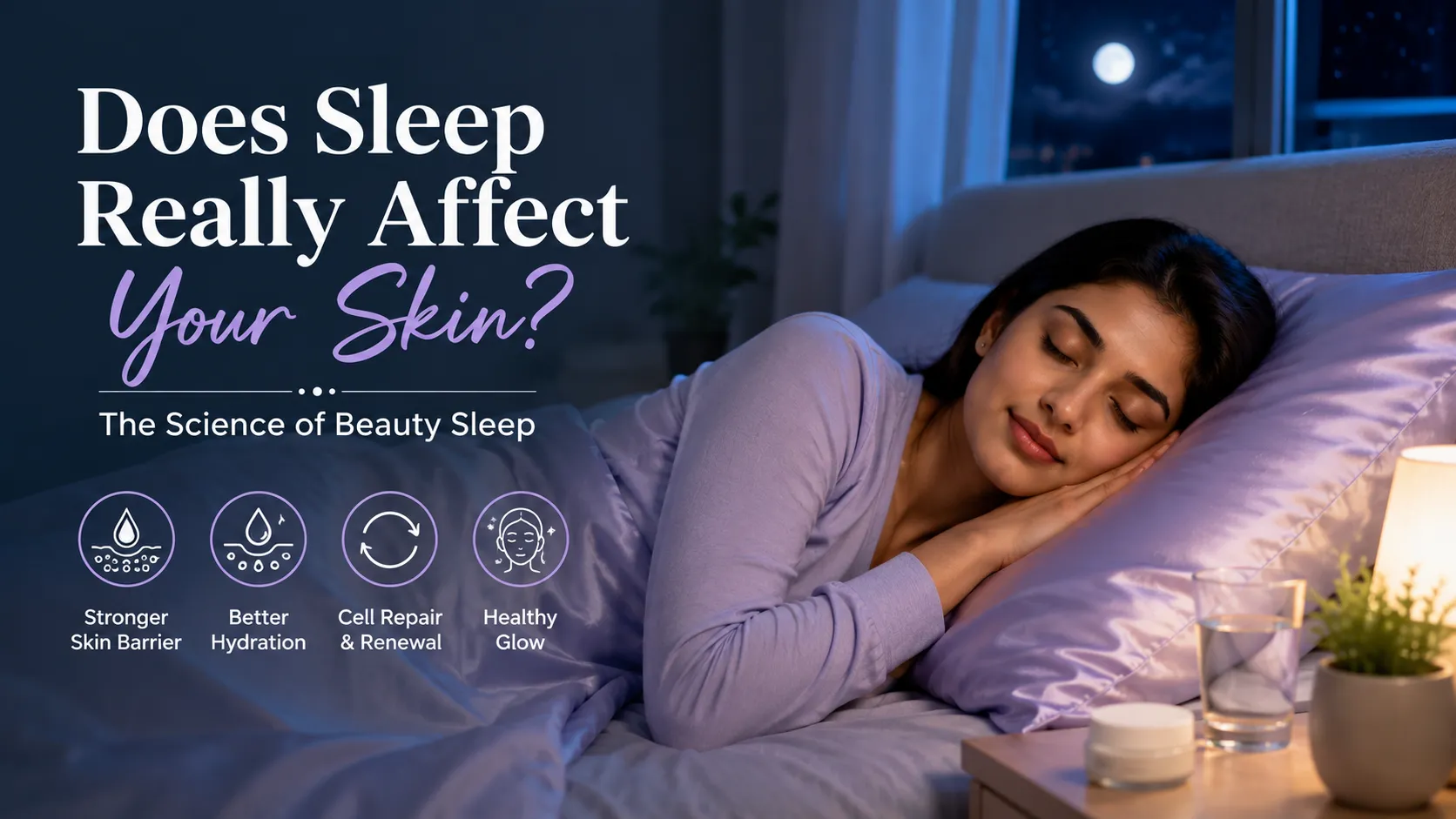
Does Sleep Really Affect Your Skin? The Science of Beauty Sleep
You follow your skincare routine carefully. You cleanse, moisturise, apply sunscreen and perhaps spend money on serums that promise brighter, smoother-looking skin.
But there is another part of your skincare routine that happens without a cleanser, serum or cream.
Sleep.
You may have heard people call it “beauty sleep”, but does sleep really affect your skin, or is that simply an old beauty saying?
There is genuine science behind the connection.
Sleep is an important period of rest and recovery for the entire body. Your skin is part of that system. Poor-quality or insufficient sleep has been associated with changes in skin barrier function, visible signs of tiredness and skin ageing.
That does not mean one late night will suddenly give you permanent wrinkles. Nor does getting eight hours of sleep replace sunscreen, moisturiser or treatment for a skin condition.
The relationship is more interesting than that.
Let’s understand what actually happens to your skin when you sleep, what repeated late nights may do to your appearance, and how to make sleep a practical part of a healthy skincare lifestyle.
First, Is “Beauty Sleep” Actually Real?
In a scientific sense, there is some truth behind the phrase.
Researchers have investigated the relationship between sleep quality and skin function. One study involving healthy women found that people classified as good sleepers showed lower intrinsic skin-ageing scores and better recovery of the skin barrier than poor sleepers.
The difference was not simply about looking sleepy.
Researchers measured skin-related factors, including transepidermal water loss and recovery after the skin barrier had been disrupted.
That gives us an important distinction:
Beauty sleep is not a magical overnight facial. Good sleep supports normal biological processes that help maintain healthy-looking skin.
Sleep therefore belongs in the same broader lifestyle conversation as nutrition, stress management, sun protection and a sensible skincare routine.
What Happens to Your Skin While You Sleep?
Your skin never completely switches off.
It remains a living, active organ 24 hours a day, and many of its functions follow the body's internal circadian rhythm — the biological clock that helps coordinate sleeping, waking and numerous physiological processes.
During the night, your body is no longer dealing with the same combination of daytime activities and environmental exposure.
Think about a normal day in India.
Your skin may encounter sunlight, UV radiation, heat, humidity, air conditioning, sweat, dust, pollution, makeup, repeated touching and cleansing.
Night gives your body a period of relative rest from many of these external factors.
This is why sleep should not be viewed only as “resting your eyes”. It is part of a much larger recovery cycle.
Your skin barrier remains especially important
The outermost layers of your skin form a protective barrier.
A healthy skin barrier helps:
- reduce excessive water loss
- protect against environmental irritants
- keep skin comfortable
- support normal hydration
- and maintain overall skin function.
Research has associated poor sleep quality with diminished skin barrier function and slower barrier recovery.
If you already struggle with dryness or sensitivity, this connection becomes particularly relevant.
7 Ways Poor Sleep Can Show Up on Your Skin
There is no single “sleep-deprived skin type”. Different people notice different changes.
However, several common concerns may become more noticeable when sleep is consistently poor.
1. Your Complexion May Look Dull and Tired
Have you ever looked in the mirror after sleeping badly and immediately thought:
“Why does my face look so tired?”
You are probably noticing several subtle changes together.
Fatigue can affect your overall facial appearance. Your skin may seem less fresh, your eyes may appear tired, and your usual natural glow can feel missing.
Importantly, “dull skin” is not a medical diagnosis. It is a visual description.
A tired-looking complexion can also be influenced by dehydration, stress, sun exposure, smoking, nutrition, illness and your skincare routine.
So if your skin looks dull after a few late nights, do not immediately assume you need another exfoliating acid or brightening serum.
Sometimes the missing part of your beauty routine is simply adequate rest.
2. Dark Circles Can Become More Noticeable
Dark circles are one of the first things people associate with lack of sleep.
But the relationship is not as straightforward as:
less sleep = permanent dark circles.
The under-eye area is naturally delicate, and its appearance can be affected by multiple factors.
These include:
- genetics
- pigmentation
- allergies
- facial anatomy
- age
- visible blood vessels
- rubbing the eyes
- dehydration
- and tiredness.
Dermatologists have noted that dark under-eye circles and a droopy or tired appearance can provide visible clues of fatigue.
This means better sleep may improve the tired appearance around your eyes, but it cannot necessarily remove genetically determined pigmentation or structural hollowness.
Don't blame every dark circle on your bedtime
If you consistently sleep well but still have dark circles, buying a “sleep mask” or sleeping an extra hour may not solve them.
Understanding the cause is more useful than treating every under-eye concern as sleep deprivation.
3. Your Eyes May Look Puffy
Poor sleep and puffy eyes often arrive together.
After a short night, you might notice swelling around the eye area, particularly in the morning.
Fluid distribution, your sleeping position, salty meals, alcohol, allergies and individual facial structure can all influence morning puffiness.
For temporary puffiness, simple measures may help:
- use a cool compress
- avoid aggressively rubbing your eyes
- stay adequately hydrated
- and return to a regular sleep routine.
If swelling is persistent, severe, painful or appears suddenly, it deserves medical attention rather than another DIY skincare hack.
4. Your Skin Barrier May Not Recover as Efficiently
This is one of the more interesting scientific connections between sleep and skin.
Your skin barrier is responsible for helping keep moisture in and unwanted irritants out.
Researchers studying sleep quality have reported differences in skin barrier recovery between good and poor sleepers.
In a study of 60 healthy women, good sleepers showed 30% greater skin barrier recovery at 72 hours after a controlled barrier-disruption procedure compared with poor sleepers.
The study also found higher baseline transepidermal water loss among poor sleepers.
In simple terms, chronically poor sleep may make it harder for skin to maintain and recover its protective barrier as efficiently.
What might a struggling barrier feel like?
You could notice:
- dryness
- tightness
- rough texture
- increased sensitivity
- stinging when products are applied
- or skin that becomes irritated more easily.
However, these symptoms have many possible causes.
Over-exfoliating, harsh cleansers, dry weather, certain medications and skin conditions can also damage or disturb the barrier.
Sleep is one piece of the puzzle, not the only one.
5. Fine Lines Can Look More Obvious
You may have noticed that fine lines seem more visible when your skin is dry or tired.
That does not necessarily mean you developed brand-new wrinkles overnight.
Skin hydration and barrier condition can affect how smooth or plump the surface looks.
Long-term sleep quality may matter more.
Research comparing good and poor sleepers found an association between chronic poor sleep quality and greater signs of intrinsic skin ageing.
There are also biological reasons researchers continue investigating this connection.
Stress hormones such as cortisol can influence skin and connective tissue. Sustained excessive cortisol activity is associated with effects on fibroblasts, keratinocytes and collagen production.
That said, skin ageing is extremely complex.
Your age, genetics, cumulative UV exposure, smoking, pollution, nutrition and skincare habits all contribute.
The biggest anti-ageing mistake?
Do not spend heavily on an anti-ageing night cream while ignoring daily sun protection.
Good sleep supports skin health.
Sunscreen protects against one of the major preventable causes of premature skin ageing: UV exposure.
You need both lifestyle habits and sensible skincare.
6. Poor Sleep May Make Stressed Skin Feel Worse
Sleep and stress frequently affect each other.
You are stressed, so you cannot sleep.
Repeat that cycle for a week and your skin may not be particularly happy either.
Psychological stress can affect skin barrier function, inflammation and certain skin conditions. Sleep deprivation itself is a physiological stressor.
This is one reason it can be difficult to separate “stress skin” from “sleep-deprived skin”.
They often happen at the same time.
If deadlines, exams, work pressure, parenting or personal stress have disrupted your sleep, suddenly adding five powerful skincare actives may not be the smartest response.
A simpler routine that protects the skin barrier can be more sensible until things settle down.
7. Breakouts May Feel Harder to Manage
“Does lack of sleep cause acne?”
This deserves a careful answer.
Acne is a multifactorial skin condition. Oil production, clogged pores, hormones, inflammation, bacteria, genetics and skincare or cosmetic products can all contribute.
So it would be inaccurate to say that one late night directly causes acne.
However, poor sleep and stress can create circumstances that may be unhelpful when you are already acne-prone.
For example, when you are exhausted you may:
- skip cleansing
- sleep with makeup on
- touch or pick your face more
- experience more stress
- eat differently
- or stop following your normal treatment consistently.
Instead of treating sleep as an acne cure, consider it part of a healthy routine that supports your overall skin and wellbeing.
If acne is persistent, painful, cystic or leaving scars, professional treatment is much more important than trying to “sleep it away”.
One Bad Night vs Chronic Poor Sleep: There Is a Difference
This point matters.
After reading about sleep and skin ageing, you might worry if you stayed awake until 2 a.m. yesterday.
There is no need to panic.
Occasional sleep loss and chronic poor-quality sleep are not the same thing.
A single bad night may leave you looking tired the next morning. You might notice puffiness, dullness or more obvious under-eye circles.
Chronic sleep restriction is a different situation because the body experiences the disruption repeatedly.
Research published in 2026 examining acute sleep deprivation found measurable skin changes after a night of sleep loss and followed participants during a subsequent recovery period, adding to evidence that circadian disruption can influence skin physiology.
The practical lesson is not to obsess over achieving perfect sleep every single night.
Focus on your overall pattern.
How Much Sleep Is Enough for Healthy-Looking Skin?
There is no special number of hours prescribed specifically for glowing skin.
Your sleep requirement is based on your overall health rather than cosmetic goals.
For most healthy adults, commonly recommended sleep duration falls around seven to nine hours per night, although individual needs can vary.
But duration is only one side of the story.
Sleep quality matters too
Eight hours in bed does not automatically mean eight hours of restorative sleep.
You might have poor sleep quality if you:
- wake repeatedly during the night
- take a very long time to fall asleep
- wake feeling exhausted despite sufficient time in bed
- have an inconsistent sleep schedule
- or regularly experience disturbed sleep.
If sleep problems are frequent or significantly affect your daytime functioning, speak with a qualified healthcare professional rather than relying solely on wellness tips.
Can Sleeping More Give You Glowing Skin?
It can help support healthier-looking skin, but sleep alone does not create perfect skin.
That distinction will save you from a lot of unrealistic beauty advice.
If you currently sleep four or five hours most nights and start consistently getting adequate, good-quality sleep, you may notice that you look less tired.
But sleep cannot:
- erase deep wrinkles
- cure acne overnight
- remove genetic pigmentation
- replace sunscreen
- permanently eliminate dark circles
- or correct every skin concern.
Think of sleep as a foundation rather than a treatment.
A strong foundation makes the rest of your routine more meaningful.
The “Beauty Sleep” Skincare Routine: What to Do Before Bed
A nighttime skincare routine does not need seven serums and a shelf full of expensive products.
For most people, consistency matters more than complexity.
Here is a practical routine.
Step 1: Cleanse Your Skin
Before going to bed, remove:
- sunscreen
- makeup
- excess oil
- sweat
- dirt
- and daily buildup.
Choose a cleanser suited to your skin type.
If your face feels painfully tight immediately after washing, your cleanser or cleansing technique may be too harsh.
Step 2: Apply Your Treatment Product — If You Need One
This step is optional.
Depending on your skin concerns and professional advice, your nighttime treatment might include ingredients used for acne, pigmentation, texture or signs of ageing.
The mistake is assuming that more products mean faster results.
They do not.
Combining too many active ingredients can irritate the skin barrier, especially if your skin is already stressed.
Step 3: Moisturise
A suitable moisturiser can help support your skin barrier and reduce moisture loss.
This becomes particularly useful if you:
- sleep in an air-conditioned room
- have dry skin
- use potentially drying active ingredients
- or frequently experience tightness.
Choose the texture according to your skin rather than blindly following a viral routine.
Oily skin can need moisturiser too.
Step 4: Actually Go to Sleep
This sounds obvious, but it is where many nighttime skincare routines fail.
You finish your routine at 10:30 p.m.
Then you open Instagram.
One reel becomes another.
You check WhatsApp.
Then YouTube.
Then one episode of a series.
Suddenly it is 1:15 a.m.
Your ₹1,500 night serum cannot negotiate with your 6:30 a.m. alarm.
A consistent bedtime can be one of the least glamorous but most practical additions to your beauty routine.
8 Sleep Habits That May Support Healthier-Looking Skin
1. Keep a Consistent Sleep Schedule
Try going to bed and waking up at approximately the same time each day.
Your body works with circadian rhythms, and consistency helps reinforce your sleep-wake pattern.
Weekend variation happens, of course.
The goal is not perfection. It is regularity.
2. Reduce Late-Night Screen Time
Phones are often the biggest bedtime distraction.
Even if you intend to check something for five minutes, stimulating content can keep you awake much longer.
Create a realistic cutoff.
If putting your phone away an hour before bed feels impossible, begin with 20–30 minutes.
A habit you actually follow is more useful than an ideal routine you abandon after two days.
3. Keep Your Bedroom Comfortable
Indian summers can make quality sleep challenging.
A hot, humid bedroom may cause sweating and discomfort, while aggressive air conditioning may leave some people's skin feeling dry.
Aim for a sleeping environment that feels comfortable, dark and quiet.
If AC makes your skin dry, focus on a gentle cleanser and suitable moisturiser rather than trying to compensate with excessive facial oils.
4. Change Your Pillowcase Regularly
Your pillowcase comes into direct contact with your face for hours.
It can accumulate oil, sweat, hair products and general residue.
Wash it regularly, particularly if you have oily or acne-prone skin.
However, do not fall for claims that a particular pillowcase fabric will magically cure acne.
Acne requires a broader approach.
5. Avoid Sleeping With Makeup On
You are tired.
The bed looks irresistible.
Still, take a few minutes to remove your makeup and sunscreen.
Sleeping with makeup repeatedly can contribute to clogged pores or irritation in some people, depending on the products being used.
Keep your cleansing routine simple enough that you can follow it even on exhausting days.
6. Don't Overdo Your Night Routine
Your skin does not need to “feel the burn” for a product to work.
If your routine includes exfoliating acids, retinoids and other active ingredients, use them appropriately.
More frequent application is not always better.
When your skin becomes irritated, temporarily simplifying your routine may be more useful than adding another repair serum.
7. Pay Attention to Your Sleeping Position — But Don't Obsess
Repeated facial compression during side or stomach sleeping may contribute to sleep lines over time.
The American Academy of Dermatology has noted that side or stomach sleeping may play a role in facial and chest sleep lines, and back sleeping may help reduce that mechanical pressure.
But comfort and good-quality sleep matter.
If forcing yourself to sleep on your back means lying awake for two hours, the trade-off probably is not worth obsessing over.
8. Treat Persistent Sleep Problems Seriously
Skincare content sometimes turns sleep into a beauty hack.
Sleep is much more important than that.
If you consistently cannot sleep, wake frequently, snore heavily, experience breathing interruptions, or remain extremely sleepy during the day, consider discussing your symptoms with a healthcare professional.
The goal of better sleep is not merely better skin.
It is better health.
What to Do With Your Skin After a Bad Night's Sleep
Had a terrible night?
Do not punish your skin the next morning.
You do not need an emergency peel, scrub or five brightening products.
Try this simple approach instead:
Morning:
Cleanse gently if needed.
Apply a hydrating product if it suits your routine.
Use moisturiser.
Finish with broad-spectrum sunscreen.
Use a cool compress around puffy eyes if it feels comfortable.
Then return to your normal routine.
If your skin feels unusually sensitive, consider reducing unnecessary exfoliation until it feels normal again.
And most importantly, prioritise getting back to your regular sleep schedule instead of trying to repair everything cosmetically.
Sleep vs Skincare: Which Matters More?
This is a false competition.
Good skin usually reflects several factors working together.
Think of it this way:
| Habit | What It Supports |
|---|---|
| Quality sleep | Normal recovery, barrier function and overall wellbeing |
| Daily sunscreen | Protection against UV damage and premature photoageing |
| Gentle cleansing | Removes daily buildup without unnecessary irritation |
| Moisturising | Supports hydration and skin barrier function |
| Balanced nutrition | Provides nutrients required for normal body and skin function |
| Stress management | Supports overall health and may benefit stress-sensitive skin |
| Dermatological treatment | Addresses specific skin conditions when necessary |
No single habit replaces all the others.
You cannot sleep eight hours and ignore sunscreen.
You cannot use SPF 50 every morning while sleeping four hours every night and expect your overall health to be unaffected.
And you cannot solve every skin condition through lifestyle changes alone.
Healthy skin is usually about consistency, not one miracle solution.
Common Beauty Sleep Myths You Should Stop Believing
Myth 1: Eight Hours of Sleep Will Remove Dark Circles
Not necessarily.
Sleep deprivation can contribute to a tired under-eye appearance, but genetics, pigmentation, allergies and facial structure also matter.
Reality:
Better sleep may improve fatigue-related appearance, but it is not a guaranteed dark-circle treatment.
Myth 2: Your Skin Completely Repairs Itself Only Between 10 p.m. and 2 a.m.
The human body does follow circadian rhythms, but the internet often turns complicated biology into rigid beauty rules.
There is no magical skincare window where missing 10 p.m. automatically means your skin loses its chance to recover.
Reality:
Regular, adequate, high-quality sleep is more meaningful than obsessing over a supposed “golden hour”.
Myth 3: Sleeping More Can Cure Acne
Acne is influenced by multiple biological factors.
Reality:
Good sleep supports general health, but persistent acne may require appropriate skincare or medical treatment.
Myth 4: Expensive Night Cream Works Better While You Sleep
A product does not become effective simply because the label says “night”.
Its effectiveness depends on ingredients, formulation, concentration, suitability and consistent use.
Reality:
A simple moisturiser appropriate for your skin can sometimes be more useful than a complicated luxury nighttime routine.
Myth 5: One Sleepless Night Permanently Ages Your Face
One difficult night may make you look tired.
That is different from permanent skin ageing.
Reality:
Your long-term habits matter much more than one imperfect night.
When Skin Changes Need More Than Better Sleep
Do not assume every skin problem is caused by poor sleep.
Consider consulting a dermatologist if you have:
- persistent or severe acne
- painful cysts or nodules
- unexplained rashes
- significant itching
- recurrent facial swelling
- rapidly changing pigmentation
- wounds that do not heal normally
- severe dryness or cracking
- or a skin concern that continues despite basic care.
Similarly, persistent insomnia or excessive daytime sleepiness deserves appropriate medical evaluation.
A skincare blog can help you understand healthy habits, but it should not replace individual medical advice.
So, Does Sleep Really Affect Your Skin?
Yes — sleep can affect your skin, and beauty sleep is more than just a catchy phrase.
Research has associated poor-quality sleep with impaired skin barrier recovery and increased signs of intrinsic skin ageing. Lack of sleep can also contribute to the familiar tired appearance many of us recognise: dull-looking skin, more noticeable under-eye circles and puffiness.
But sleep is not a miracle cosmetic treatment.
Getting enough rest will not automatically cure acne, erase pigmentation or reverse every wrinkle.
The healthiest approach is much simpler.
Sleep well. Protect your skin from the sun. Cleanse gently. Moisturise appropriately. Use evidence-based treatments when needed. And give your routine enough time to work.
Your skin does not need a perfect lifestyle.
It benefits from consistent healthy habits.
So tonight, after applying your moisturiser, consider putting the phone down a little earlier.
Your next skincare step might simply be closing your eyes.
Frequently Asked Questions About Sleep and Skin
1. Does sleep really affect your skin?
Yes. Research suggests that sleep quality is associated with skin barrier function, recovery and signs of intrinsic skin ageing. Poor sleep can also make your face look visibly tired.
2. How many hours should I sleep for glowing skin?
There is no special “glowing skin” sleep requirement. Most adults generally need around seven to nine hours of sleep, although individual requirements vary. Quality and consistency also matter.
3. Can lack of sleep cause pimples?
Lack of sleep is not considered a single direct cause of acne. However, poor sleep can occur alongside stress and lifestyle changes that may make acne management more difficult.
4. Does sleeping late make your skin darker?
Sleeping late does not directly change your natural skin colour. However, fatigue can make the complexion look dull, and under-eye darkness may appear more noticeable.
5. Can better sleep reduce dark circles?
It may improve dark circles related to fatigue, but not all dark circles are caused by poor sleep. Genetics, pigmentation, allergies and facial structure can also contribute.
6. Can lack of sleep cause wrinkles?
Chronic poor sleep quality has been associated with greater signs of intrinsic skin ageing. However, wrinkles develop due to many factors, including age, genetics, UV exposure and lifestyle.
7. Does your skin repair itself while you sleep?
Skin remains biologically active around the clock, with several functions influenced by circadian rhythms. Sleep supports the body's overall recovery processes and is associated with healthy skin barrier function.
8. Can one night of bad sleep damage your skin?
One poor night can temporarily make your face appear tired, dull or puffy. Occasional sleep loss should not be confused with the potential effects associated with chronically poor sleep.
9. Is sleeping early better for skin?
A regular sleep schedule that allows adequate, good-quality sleep is more important than following an arbitrary “beauty sleep” bedtime. Consistency is generally the more useful goal.
10. What should I apply to my face before sleeping?
For a basic routine, remove makeup and sunscreen, cleanse gently and apply a moisturiser suited to your skin. Specific treatment products can be added according to your skin concerns and tolerance.
Final Takeaway
The phrase “beauty sleep” may sound old-fashioned, but its basic message has survived for a reason.
Your skin is connected to the rest of your body.
When sleep, stress, sun exposure and daily habits are consistently neglected, even an expensive skincare routine has limits.
Instead of searching for a product that promises an overnight transformation, build a routine your skin can rely on every day — gentle care in the bathroom, sun protection in the morning and enough rest at night.
Want to Build a Smarter Skincare Routine?
Explore more practical, easy-to-understand skincare guides on DailySkinTips to learn about skin barriers, oily skin, serums, seasonal skincare and everyday habits that can help you care for your skin without unnecessary complications.