Have you ever picked up two packets of breakfast cereal, biscuits or namkeen and wondered which one is actually the better choice? Both packages may look attractive. One might advertise itself as high in protein, while another highlights whole grains or natural ingredients. But when you turn the packets around, the nutritional information can tell a completely different story.
This is where food labels become useful. They help you understand what goes into a packaged product instead of relying entirely on advertising. Yet many shoppers overlook this information because the numbers, ingredients and nutritional terms can seem confusing.
You do not need to memorise complicated nutrition terms to make better grocery choices. Start by checking the ingredients, serving size and a few important nutrient values. With regular practice, you will become more comfortable comparing products and recognising what suits your household.
For Indian households, this habit is particularly useful. From breakfast mixes and packaged snacks to flavoured yoghurt, instant noodles and ready-made sauces, there are many products worth comparing before adding them to your shopping basket.
Let's look at what the information on a food packet actually means and how you can use it to make more informed everyday choices.
1. Start With the Ingredient List
Before looking at attractive claims on the front of a packet, turn it around and read the ingredient list.
In most packaged foods, ingredients are listed from the highest quantity to the lowest by weight. Therefore, the first few ingredients can give you a useful idea of what makes up most of the product. Always read the complete list, especially when checking sweeteners, oils and potential allergens.
Consider two packets of breakfast biscuits. The first lists whole wheat flour among its main ingredients. The second lists refined flour and sugar near the beginning. Although both may look similar, their composition is different.
Here are a few things worth checking:
- Main ingredients: Notice which ingredients appear first.
- Type of flour: Whole wheat flour and refined wheat flour do not provide the same amount of fibre.
- Sweeteners: Look for ingredients such as sucrose, glucose syrup, fructose and malt syrup.
- Added fats: Check which oils or fats have been used.
- Allergens: Look for milk, peanuts, soy, wheat, sesame and tree nuts if you have an allergy.
A shorter ingredient list does not automatically mean a product is healthier. A simple product with several familiar ingredients may still contain considerable salt, sugar or saturated fat.
The important thing is to understand what the product contains and how frequently you plan to eat it.
2. Learn to Understand the Nutrition Information Panel
The nutrition information panel provides a breakdown of the nutrients present in packaged food.
Depending on the product and applicable labelling requirements, it may include energy, protein, carbohydrates, total sugars, added sugars, total fat, saturated fat, trans fat, sodium and certain vitamins or minerals.
If the nutrition panel looks confusing at first, focus on a few values that matter when comparing similar products. Energy, protein, carbohydrates, added sugars, total fat and sodium are useful starting points. You can then check fibre and other nutrients according to the type of food you are buying.
Energy
Usually measured in kilocalories (kcal), it tells you how much energy a quantity of food provides.
Protein
Supports muscle maintenance, growth and tissue repair.
Carbohydrates
Provide energy and include different components such as sugars and starches.
Total sugars
Includes naturally occurring sugars and added sugars.
Total fat
Shows the amount of fat present in the stated quantity of food.
Sodium
An essential mineral that needs to be consumed in appropriate amounts.
For example, when choosing a breakfast cereal, looking at its protein and fibre content alongside added sugar can provide a more useful picture than checking calories alone.
Remember that one nutritional number cannot determine the overall quality of a food.
3. Check Serving Size Before Comparing Calories
A nutrition label can appear misleading when you overlook the quantity used for its calculations. Before comparing two products, check whether their nutritional values refer to the same serving size or to 100 grams. This small check prevents you from comparing two different quantities as though they were equal.
Some products display nutritional information per serving, while others also provide values per 100 grams or 100 millilitres. These measurements are not interchangeable.
Imagine that a snack packet contains two servings and lists 150 calories per serving. If you eat the entire packet, you consume approximately 300 calories.
The same calculation applies to protein, carbohydrates, sugar and fat.
Consider this hypothetical comparison between two breakfast snacks:
Nutritional information
| Nutritional information | Product A | Product B |
|---|---|---|
| Serving size | 30 g | 30 g |
| Energy | 120 kcal | 135 kcal |
| Protein | 4 g | 3 g |
| Total sugars | 3 g | 7 g |
| Fibre | 3 g | 1 g |
These figures are illustrative examples, not laboratory-tested product information.
Both snacks provide energy, but Product A has more protein and fibre and less total sugar in the stated serving.
That makes it an interesting option to compare, although the final decision should also consider ingredients, price, taste and individual nutritional needs.
A useful tip: If two products have different serving sizes, compare their values per 100 grams wherever available. This makes the comparison more meaningful.
4. Understand the Difference Between Total Sugar and Added Sugar
Sugar is naturally present in foods such as milk and fruit. However, manufacturers may add additional sugar to improve the taste of packaged products.
This is why checking the sugar information on food labels matters.
Products such as flavoured yoghurt, breakfast cereals, packaged drinks, biscuits and sweetened sauces are worth examining carefully.
Look for ingredients such as:
- Sucrose
- Glucose syrup
- Fructose
- Corn syrup
- Malt syrup
The total sugar figure combines sugars naturally present in ingredients with those added during food production. If the label provides a separate added sugar value, check it to understand how much additional sugar has been used. This distinction is particularly useful when comparing flavoured yoghurt, breakfast cereals and packaged drinks.
Honey and syrups should not automatically be considered sugar-free alternatives. They also contribute free sugars.
The World Health Organization recommends keeping free sugar consumption below 10% of total daily energy intake, with additional benefits potentially available at lower levels.
This does not mean that every sweet food needs to disappear from your diet. Instead, pay attention to how frequently added sugars appear in the products you consume.
For example, plain curd with fresh fruit is one alternative to regularly choosing heavily sweetened flavoured yoghurt.
5. Pay Attention to Sodium in Indian Packaged Foods
Sodium is necessary for normal nerve function, muscle activity and fluid balance. However, regularly consuming too much can contribute to increased blood pressure.
Some familiar Indian grocery products deserve a closer look, particularly instant noodles, packaged soups, salted namkeen, ready-made sauces, pickles and savoury snacks.
Salt may be added for flavour and preservation, so the actual sodium content is not always obvious from the taste.
When comparing two similar products, check their sodium values using the same measurement.
For instance, if you regularly purchase packaged savoury snacks, comparing the sodium content of different options can help you make a more informed selection.
Salt and sodium are related, but they are not the same thing. Common table salt is sodium chloride, which contains sodium as one of its components. If a nutrition panel lists sodium in milligrams, do not compare that number directly with the weight of salt in grams.
People who have been advised to restrict sodium because of a medical condition should follow their healthcare professional's recommendations rather than relying on general shopping advice.
6. Know Which Types of Fat Are Present
Fat is an essential nutrient. It provides energy, supports normal cell functions and helps the body absorb vitamins A, D, E and K.
However, different types of fat have different nutritional effects.
Saturated fat
Commonly found in butter, ghee, cream, fatty meat and certain packaged foods. Excessive intake can negatively affect cardiovascular health.
Unsaturated fat
Found in nuts, seeds, avocados and many plant-based oils. These fats are generally preferred as part of a balanced eating pattern.
Trans fat
Industrially produced trans fats have no established health benefit and should be avoided as much as possible.
Do not choose a product simply because its packaging says low-fat. A product with less fat may still contain considerable added sugar or other ingredients worth checking.
Look at the complete nutrition panel instead of judging a product by one claim.
7. Do Not Depend Entirely on Front-of-Package Health Claims
Food manufacturers use different descriptions to communicate product features. A claim on the front of a packet usually highlights one particular feature of the product. It may tell you something about protein, sugar or added vitamins, but it cannot show the complete nutritional picture. The ingredient list and nutrition panel are still important when deciding whether the product suits your everyday diet.
Here are a few examples.
High Protein
Indicates a protein-related claim under applicable criteria. It does not automatically mean the product is suitable for everyday consumption.
Sugar-Free
Does not necessarily mean the product contains no carbohydrates or calories.
Multigrain
Means multiple grains are included, but they may not all be whole grains.
Natural
This word alone does not establish that a product is low in sugar, sodium or fat.
Fortified
Certain nutrients have been added to the product. Fortification may help improve nutrient intake, but it does not automatically make every other ingredient nutritionally desirable.
Imagine choosing between two breakfast drinks. One highlights added vitamins, while the other highlights protein. Neither claim alone tells you which product is more suitable.
Check the ingredients, serving size and nutritional values before deciding.
8. Look for Fibre and Whole-Grain Ingredients
Dietary fibre plays an important role in digestion and helps maintain normal bowel movements. Certain types of fibre also support beneficial gut bacteria.
In Indian diets, fibre can come from everyday foods such as dal, chana, vegetables, fruits, whole grains, nuts and seeds.
When purchasing packaged products, look for ingredients such as:
- Whole wheat
- Oats
- Barley
- Brown rice
- Millets
- Legumes
- Seeds
Do not assume that every multigrain product contains a substantial amount of fibre. Check the actual fibre quantity on the nutrition panel.
For example, two packets of bread may both mention multiple grains on the front. However, their fibre content and main ingredients may be quite different.
At home, simple changes such as including vegetables with lunch, eating whole fruits and regularly adding pulses to meals can help increase fibre intake.
Increase fibre gradually and drink sufficient water.
9. Check FSSAI and Other Important Food Safety Details
When purchasing packaged food in India, nutritional information is not the only detail worth checking.
In India, packaged food labels are governed by applicable Food Safety and Standards Authority of India (FSSAI) regulations. These rules cover important consumer information, including product identification, ingredient declarations, nutritional details and other labelling requirements. The exact information required can vary according to the food category and applicable regulations.
Depending on the product and applicable regulations, look for:
- FSSAI logo and licence number: These help identify the relevant food business operator and its licence information.
- Vegetarian or non-vegetarian symbol: Helps identify the declared dietary classification of the product.
- Allergen declaration: Important for people who need to avoid specific ingredients.
- Batch or lot number: Helps identify a particular production batch.
- Date marking: Check the applicable expiry or use-by information and any best-before declaration.
- Storage instructions: Follow these carefully, especially for products requiring refrigeration.
- Manufacturer details: Help identify the business responsible for the packaged food.
A valid-looking package does not remove the need to check its physical condition. Avoid products with broken seals, leakage, unusual swelling or other signs of damage.
Also remember that food safety depends on proper storage after opening. Always follow the instructions provided on the packet.
10. Try This Simple Grocery Shopping Comparison
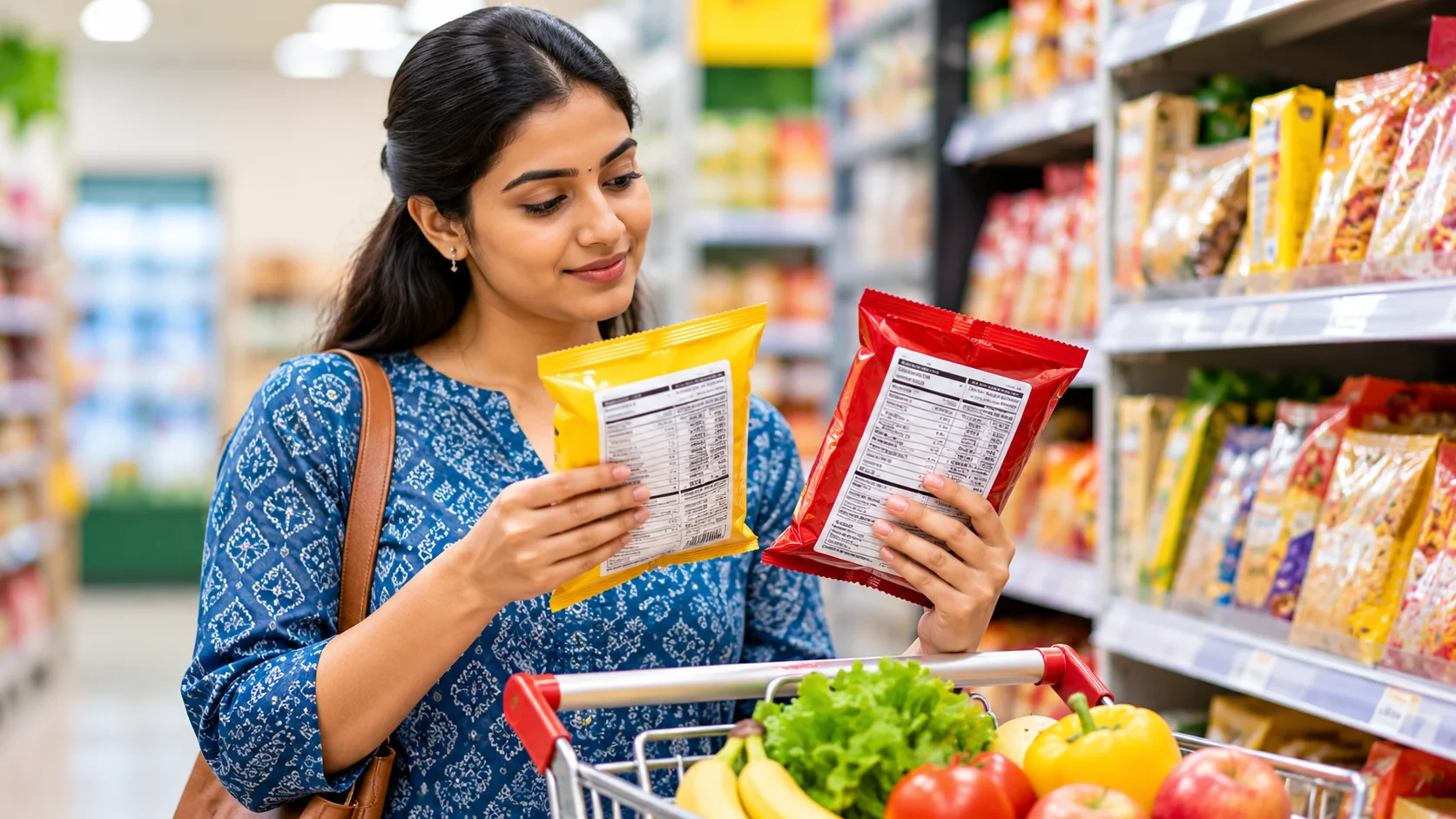
The next time you visit a supermarket, choose two products from the same category. Breakfast cereals, packaged bread and biscuits are good examples.
Instead of selecting the familiar brand immediately, spend a minute comparing the information on both packets.
What to check
| What to check | What it tells you |
|---|---|
| Ingredients | Main ingredients and grain type |
| Serving size | Quantity used for comparison |
| Added sugar | Additional sweetening ingredients |
| Fibre | Contribution to daily fibre intake |
| Protein | Amount of protein per serving |
| Sodium | Sodium content of the product |
| Saturated fat | Amount of saturated fat |
| Price | Cost for an equivalent quantity |
You do not need a complicated scoring system to compare everyday groceries. Put the two labels side by side and check their ingredients, serving sizes, added sugars and fibre values. Once you compare equal quantities, the differences become easier to understand and can help you choose according to your preferences and budget.
A more expensive product is not necessarily more nutritious. Similarly, a popular brand is not automatically the best choice for every household.
Choose products according to their nutritional composition, your preferences, household budget and the way they fit into your overall eating pattern.
11. Choose Products That Suit Your Household
Nutritional needs differ from person to person.
A growing teenager, an older adult, someone who exercises regularly and a person managing a medical condition may have different dietary requirements.
Food preferences also influence purchasing decisions. Some families follow vegetarian diets, while others include eggs, fish or meat.
A nutritious grocery basket does not have to depend on expensive imported products or trendy health foods. Everyday ingredients such as dal, chana, seasonal vegetables, curd, whole grains and fresh fruits can provide variety. The important part is choosing suitable foods and combining them in a way that meets your household's nutritional needs.
A balanced eating pattern also plays a role in overall wellness. You can explore more everyday lifestyle tips in our guide to Natural Skin Care: A Simple Daily Routine for Healthy, Glowing Skin.
Dal, chickpeas, seasonal vegetables, fruits, curd, whole grains, nuts and seeds can all contribute to a varied diet.
If you have diabetes, kidney disease, food allergies or another medical condition, certain food choices may require individual attention. A registered dietitian can help you understand which products are appropriate for your circumstances.
The purpose of reading labels is not to make every grocery purchase stressful. It is to give you a better understanding of the food you bring home.
If you are interested in the connection between nutrition, everyday habits and self-care, explore our Beauty Beyond Products e-book in the DailySkinTips library.
Final Thoughts
A food packet tells you much more than its brand name, price or advertising claims. The ingredient list, nutrition panel, serving size and safety information can help you understand what you are actually purchasing.
You do not need to memorise every nutritional term before visiting a supermarket. Start by comparing two similar products and noticing the differences in their ingredients, sugar, sodium and fibre.
Over time, these small checks become easier. You may also find that familiar products are not always the most suitable choices once you understand their nutritional composition.
Good nutrition is not about finding one perfect packaged product. It is about building a varied eating pattern that suits your needs, preferences and budget.
Before adding your next grocery purchase to the basket, turn the packet around and spend a few seconds checking its ingredients and nutritional values. You may discover differences that are not visible from the front packaging. Over time, this simple habit can make comparing products easier and help you make more informed choices for your household.
Disclaimer
This article is intended for general educational purposes only and does not replace personalised medical or nutritional advice. People with medical conditions, food allergies or specific dietary requirements should consult a qualified healthcare professional or registered dietitian.
Frequently Asked Questions
1. What should I check first when reading a food label?
Start with the ingredient list and serving size. Then examine the nutrition information, especially added sugars, sodium, protein, fibre and fats.
2. Is a product with fewer calories always healthier?
No. Calories describe the energy a food provides, not its complete nutritional quality. Ingredients, protein, fibre, vitamins and minerals also matter.
3. Are packaged foods always unhealthy?
No. Plain oats, frozen vegetables, unsalted nuts and some canned pulses can be convenient additions to a balanced diet. Their suitability depends on ingredients, preparation and portion size.
4. How can I recognise added sugar in packaged products?
Check the ingredient list for sweeteners such as sucrose, glucose syrup, fructose and malt syrup. Also examine the added sugar value wherever it is declared.
5. Does multigrain mean whole grain?
Not necessarily. A multigrain product contains more than one type of grain, but those grains may be refined. Check the ingredient list to understand what has actually been used.
6. Why should I check the FSSAI licence number?
It helps identify the food business operator responsible for the packaged product and its licensing information. It should not be treated as independent proof that every nutritional claim is accurate.
7. Can reading food labels improve everyday eating habits?
Yes. Understanding ingredients and nutritional values can help you compare products, recognise unnecessary added ingredients and make more informed grocery decisions.