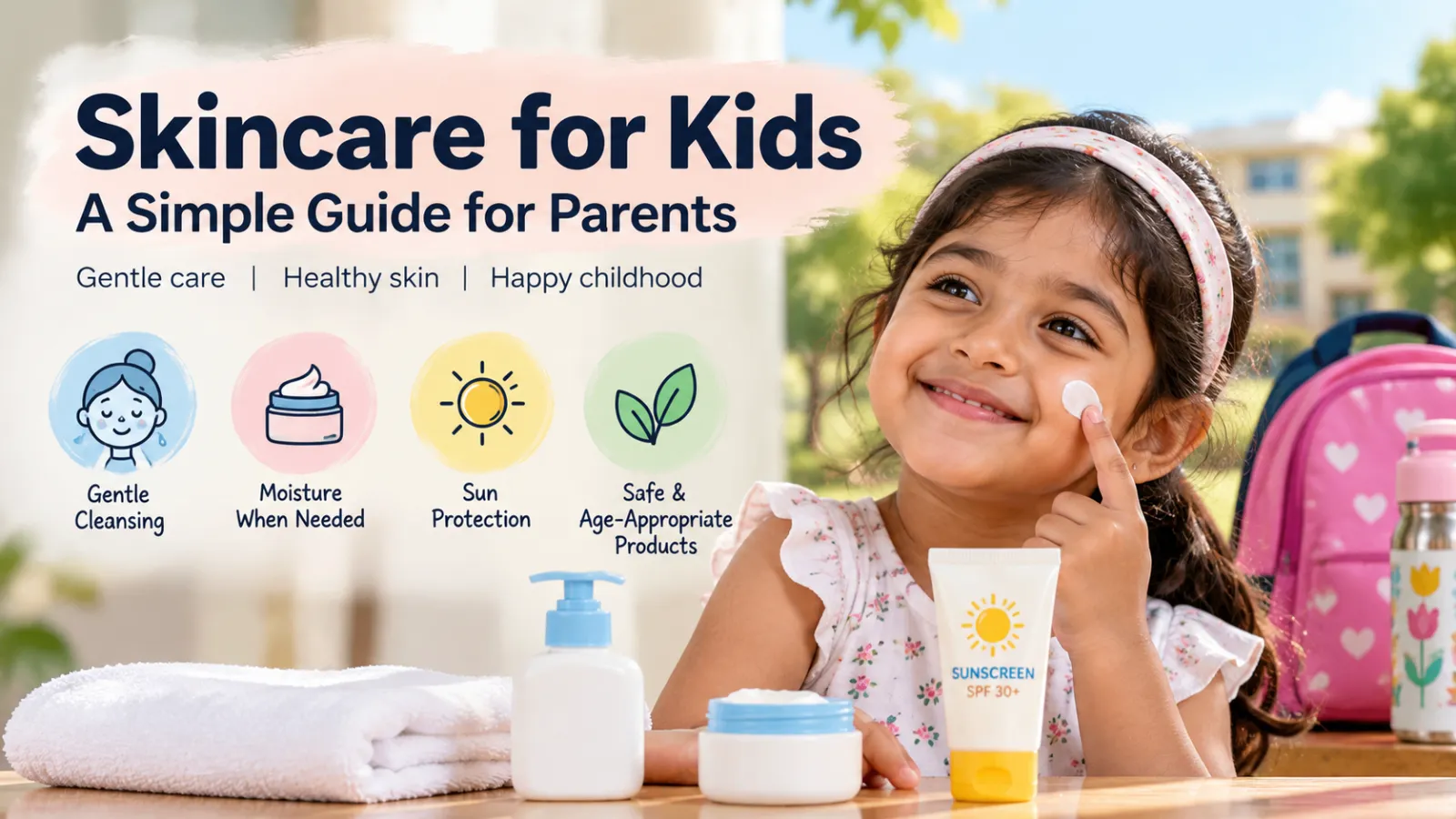
A school bag, a water bottle and a sunscreen tube may seem like an unusual combination, but for many families, they belong to the same morning routine. Children spend time outdoors, wash their hands repeatedly, sweat during games and sometimes develop dry patches that make ordinary activities uncomfortable. Looking after their skin should be just as practical as packing their lunch.
Skincare for kids is about protecting the skin and responding to its needs, not following adult beauty trends. Most children between the ages of 3 and 12 do not need a collection of facial products. Gentle cleaning, moisturising when necessary and sensible sun protection are the foundations of everyday care.
Indian weather adds another consideration. Hot afternoons, humid monsoon days, dry winter air and long hours in air-conditioned classrooms can affect how skin feels. A child with comfortable skin may need very little, while a child with recurring irritation may require a more specific plan.
This guide explains how parents can build a simple kids skin care routine, choose suitable products, recognise common mistakes and know when a skin concern needs professional attention.
Why children's skincare should stay simple
A child's skin already has natural ways to retain moisture and protect the body. The aim of daily care is to support those functions without exposing the skin to unnecessary products or repeated friction.
Consider two everyday situations. After playing outside, a child may need help washing away visible dust and sweat. On another day, the same child's cheeks may feel rough after a bath.
Before buying anything, ask three questions:
- Will this product address that concern?
- Is it suitable for the child's age and skin condition?
These questions help separate useful skincare from unnecessary purchases. A product is not essential simply because it is labelled for children or appears frequently in social-media routines.
Parents should focus on comfort and protection rather than fairness, flawless appearance or changing a child's natural complexion.
A daily skincare routine that fits family life
A routine works best when it fits into activities that already happen at home. Children are more likely to follow a few understandable steps than a long list of instructions.
Morning: prepare for the day
If the face is clean, a gentle rinse with water may be sufficient. Use a mild cleanser when needed to remove dirt or other residue, and avoid scrubbing.
If the skin feels dry, apply a suitable moisturiser. When the child will spend time outdoors, plan sun protection before leaving home. This may include sunscreen, a hat, protective clothing and access to shade.
Children do not need a toner, facial serum or exfoliating treatment simply because these products are part of an adult's routine.
After school or outdoor play
Sweat, dust and food can collect around the face and neck during the day. Clean visible dirt gently with water and, when appropriate, a mild cleanser. Pat the skin dry with a soft towel.
Repeatedly washing the face with soap can make some children uncomfortable, especially if their skin is already dry.
Evening: check how the skin feels
Before bed, remove sunscreen and visible dirt. Look for signs of dryness, irritation or discomfort. Apply moisturiser if required.
If a child has a diagnosed skin condition, follow the treatment plan provided by their healthcare professional. A general routine is not a replacement for individual medical advice.
Choosing skincare products for kids
Store shelves often make children's skincare look more complicated than it is. Instead of choosing products by packaging, start with their purpose and directions.
What to look for in a gentle face wash for kids
A cleanser should remove dirt without leaving the face tight, stinging or uncomfortable. Look for a mild product suitable for the child's age and avoid harsh scrubs or strong exfoliating washes for everyday use.
Fragrance-free products can be a sensible starting point for children with sensitive skin. The American Academy of Dermatology explains that fragrance-free and unscented are not necessarily the same: an unscented product may contain fragrance used to mask another smell. See its guidance on eczema-friendly products.
If a cleanser causes a repeated reaction, stop using it. Do not assume the skin must become accustomed to burning or persistent redness.
Choosing a moisturiser for a child's face
Moisturiser is useful when the skin feels rough, tight or flaky. A straightforward cream or lotion intended for children or sensitive skin may be enough for mild dryness.
Creams and ointments tend to be richer than lotions, so they may suit children whose skin loses moisture easily.
Apply moisturiser gently after washing if dryness is a concern. If your child has eczema or persistent irritation, ask a healthcare professional about appropriate emollients rather than relying on ordinary cosmetic products alone.
Do you need an expensive product?
Not necessarily. Price, attractive packaging and influencer popularity do not establish that a product is suitable for a child.
Look for clear ingredient information, age guidance, directions for use and a product that addresses an actual need. Introduce one new product at a time so that a reaction, if one occurs, is easier to investigate.
Sunscreen for kids: protection for outdoor days
Sun protection matters during school outings, sports, holidays and ordinary outdoor play. Sunscreen should be part of a wider plan that includes shade and suitable clothing.
For children aged 3–12, choose a broad-spectrum, water-resistant sunscreen with SPF 30 or higher. Apply it according to the label before outdoor exposure, covering exposed areas such as the face, ears, neck and hands.
Reapply at least every two hours while outdoors and follow the label's instructions after swimming, sweating or towel drying. No sunscreen provides complete protection, and no product should be treated as waterproof.
A hat, protective clothing and shade add useful layers of protection. On days with strong sunlight, arrange outdoor activities thoughtfully where possible. Cloud cover does not eliminate ultraviolet exposure.
Some children find particular sunscreens uncomfortable. A fragrance-free formula may be worth considering for sensitive skin; products containing zinc oxide or titanium dioxide are another option for some children. The full formulation and the child's response matter more than a single ingredient claim.
For further guidance, read the US FDA's sun-safety recommendations.
Natural skincare for kids: familiar ingredients are not always safer
Parents may be tempted to try lemon juice, essential oils, homemade face packs or other household ingredients. These remedies can sound gentle because they are familiar, but familiarity does not establish safety.
Lemon juice can irritate skin, and some plant extracts and essential oils can trigger allergic reactions. Homemade mixtures may also have unpredictable concentrations or contain ingredients that are unsuitable for irritated skin.
Avoid applying undiluted essential oils, acidic kitchen ingredients or abrasive mixtures to a child's face. If you prefer products containing botanical ingredients, choose a properly formulated product with clear directions and check how the skin responds.
Be cautious of marketing terms such as "chemical-free" or "non-toxic" when they are used without meaningful explanation. All skincare products contain chemicals in the scientific sense. What matters is whether the product is appropriately formulated, suitable for its intended use and tolerated by the child.
Natural skincare is not automatically better than a simple, well-formulated moisturiser.
Helping children with dry or sensitive skin
Dryness can appear after frequent bathing, exposure to cold air or use of a harsh cleanser. Sensitive skin may also react to fragrance, friction or particular ingredients.
Start with the basics: use lukewarm water, avoid scrubbing, choose a mild cleanser when needed and apply a suitable moisturiser after washing if the skin is dry.
Pay attention to patterns. If redness or itching repeatedly follows the use of a new product, stop using it and note the product's name and when the reaction began.
Children with eczema often need a more consistent plan. NICE recommends regular use of unperfumed emollients as a foundation of care for children with atopic eczema. Follow a clinician's instructions about treatment, product choice and application.
Do not begin steroid creams, antibiotic creams or antifungal medicines on a child's face without appropriate medical advice.
Seek medical advice if itching persists, rashes keep returning, skin becomes cracked or symptoms affect sleep. Get urgent medical help for a rapidly spreading painful rash, a rash accompanied by serious illness, or swelling or breathing difficulty after exposure to a product.
Skincare through India's seasons
A useful routine changes with conditions, not simply with the month on the calendar.
Summer: sweat and sun exposure
Children may sweat heavily during sports and outdoor play. Help them change out of wet clothing, gently clean areas where sweat and dirt collect, and dry skin folds carefully.
Use sunscreen and protective clothing when outdoors. Encourage water breaks and time in a cooler environment during very hot weather. Avoid layering unnecessary scented products onto sweaty skin.
A persistent rash should not automatically be treated with a cosmetic cream. If the skin becomes painful, symptoms worsen or the child appears unwell, seek medical advice.
Winter: dryness and rough patches
Cold, dry air and hot baths can leave skin feeling tight. Use lukewarm water and apply moisturiser when needed, especially to areas that repeatedly become dry.
If ordinary moisturising does not help, or the skin becomes inflamed or cracked, consult a healthcare professional. Recurring symptoms may need more specific care.
Monsoon: damp clothes and humidity
During humid weather, change wet clothing and gently dry the skin after bathing or playing in the rain. Avoid rubbing irritated areas. If a rash spreads, becomes painful or does not improve, seek medical advice rather than trying several products at once.
What changes as children grow?
A skincare routine should reflect a child's needs rather than a birthday or a trend.
Ages 3–5: Keep the routine short and supervised. An adult should choose suitable products, help with washing and ensure that sun protection is used appropriately.
Ages 6–9: Children can learn to wash gently, dry their faces without rubbing and understand why sunscreen matters. Parents should still supervise product choice and application.
Ages 10–12: Some children begin to experience oily skin or early acne as puberty approaches. Gentle cleansing and moisturising may be enough for basic care. If acne becomes persistent, painful or distressing, seek age-appropriate advice from a healthcare professional rather than copying an adult's skincare routine.
At every age, explain that skincare is about health and comfort. Avoid suggesting that children need products to change their skin colour or achieve a flawless appearance.
Ingredients and trends to approach carefully
Preteen beauty routines may feature exfoliating acids, retinoids, facial peels and multiple active ingredients. Some of these ingredients have legitimate uses in particular circumstances, but they are not necessary for routine care of healthy children's skin.
Avoid experimenting with strong exfoliants, aggressive peels or adult anti-ageing products on young children. Acne treatments should be selected according to the child's age, the condition and appropriate medical guidance.
Do not assume that a product is suitable just because it says "dermatologist recommended", "clean" or "natural". Read the complete label, follow age guidance and consider whether the product serves a real purpose.
The same principle applies to products marketed to preteens. A brand's target audience does not guarantee suitability for every child. Choose according to the child's actual needs rather than online popularity.
When skincare is not enough
Not every skin concern can be solved by changing a cleanser or moisturiser. Persistent itching, recurring rashes, unexplained patches, painful cracks and troublesome acne may require professional assessment.
Keep a brief record of when symptoms began, where they appear and which products were used. Do not rely on online photographs alone to diagnose a skin condition, and avoid applying several new treatments at once.
If the child appears seriously unwell, the rash spreads quickly, or there is significant pain or fever, seek prompt medical care. Swelling of the mouth or throat or difficulty breathing after a product exposure requires emergency assistance.
A practical takeaway for parents
Children do not need a long skincare routine to look after their skin. Begin with gentle washing, moisturise when needed, protect exposed skin from the sun and avoid products that cause irritation.
Adjust the routine to the weather and the child's needs. For recurring or concerning symptoms, seek professional advice instead of repeatedly trying cosmetic products.
At DailySkinTips.in, the aim is to help parents make informed choices without unnecessary complexity. A thoughtful routine is not the one with the most steps; it is the one that supports your child's comfort, safety and everyday life.
FAQ section
How can I care for my child's dry skin?
Use lukewarm water, avoid harsh cleansing and apply a suitable moisturiser after washing if needed. Persistent itching, cracking or recurring dryness deserves professional advice.
Should children use sunscreen in India?
Sunscreen is useful for exposed skin during outdoor activities. Choose broad-spectrum, water-resistant sunscreen with SPF 30 or higher, follow the label and combine it with shade, hats and protective clothing.
What skincare routine does a 10-year-old need?
A 10-year-old generally needs basic cleansing, moisturiser when necessary and sun protection. If acne or persistent oiliness develops, seek age-appropriate advice rather than copying an adult routine.
Which skincare ingredients should parents use carefully?
Avoid casually introducing strong exfoliating acids, harsh scrubs, facial peels, essential oils and adult anti-ageing treatments. Suitability depends on the ingredient, formulation, intended use and child's skin.
Which moisturiser is suitable for a child's dry skin?
A simple cream or lotion suitable for the child's age and skin condition may help with mild dryness. If the skin is persistently itchy, cracked or inflamed, ask a healthcare professional for advice.
When should I seek medical advice for my child's skin?
Seek professional advice for persistent itching, recurring rashes, cracked skin or acne that causes pain or distress. Rapidly worsening symptoms, serious illness or breathing difficulty require urgent medical attention.
conclusion
Children's skincare can stay simple: clean gently when needed, moisturise dry skin, use sun protection outdoors and avoid products that cause irritation. Pay attention to changes in your child's skin, and seek professional advice when symptoms persist or cause concern. Choose products for your child's actual needs, not because they are trending.